Today, with the continuous adoption of AI applications, AI is gradually moving from an external assistive tool into core enterprise business processes. From intelligent customer service and knowledge-base Q&A to operations assistants, risk analysis, and equipment diagnostics, enterprises no longer expect AI to merely answer questions—they expect it to participate in decision-making, trace root causes, and explain outcomes. As a result, data retrieval has become increasingly complex.
Enterprise users are no longer limited to asking whether a few similar pieces of content can be found. They continue to ask:
In this context, simply retrieving a few semantically similar text chunks is no longer sufficient for real-world business retrieval requirements. What enterprise AI retrieval truly needs to solve is how to connect business data, relational context, textual evidence, semantic signals, and analytical results—enabling AI to genuinely understand the business.
In other words, enterprises do not need a single-point retrieval tool, but a hybrid retrieval pipeline capable of carrying complex business problems.
Taking IoT or industrial IoT scenarios as an example, an operations agent may receive a question like: In the last 24 hours, which devices showed abnormal fluctuations? Are these anomalies concentrated in a specific region, firmware version, or batch of sensors? Are there identical error codes in the logs? Are there similar descriptions in maintenance records? Have similar failures occurred historically?
At first glance, these are simple natural language questions. But in execution, they are decomposed into a series of data operations:
Therefore, enterprise AI retrieval is not simply about finding similar content. It must connect business rules, relational paths, textual evidence, semantic signals, and analytical reasoning into a single problem-solving chain.
Behind this chain lies a mixture of retrieval and computation types: structured filtering, graph traversal, full-text search, semantic retrieval, as well as aggregation and ranking queries. The characteristics are clear: heterogeneous data types, long query paths, strong contextual dependency, and iterative filtering and reasoning over continuously updated data.
Traditional architectures addressing such hybrid retrieval scenarios often rely on a multi-system composition approach. Using the device diagnostics example above, the application layer may need to query multiple systems:
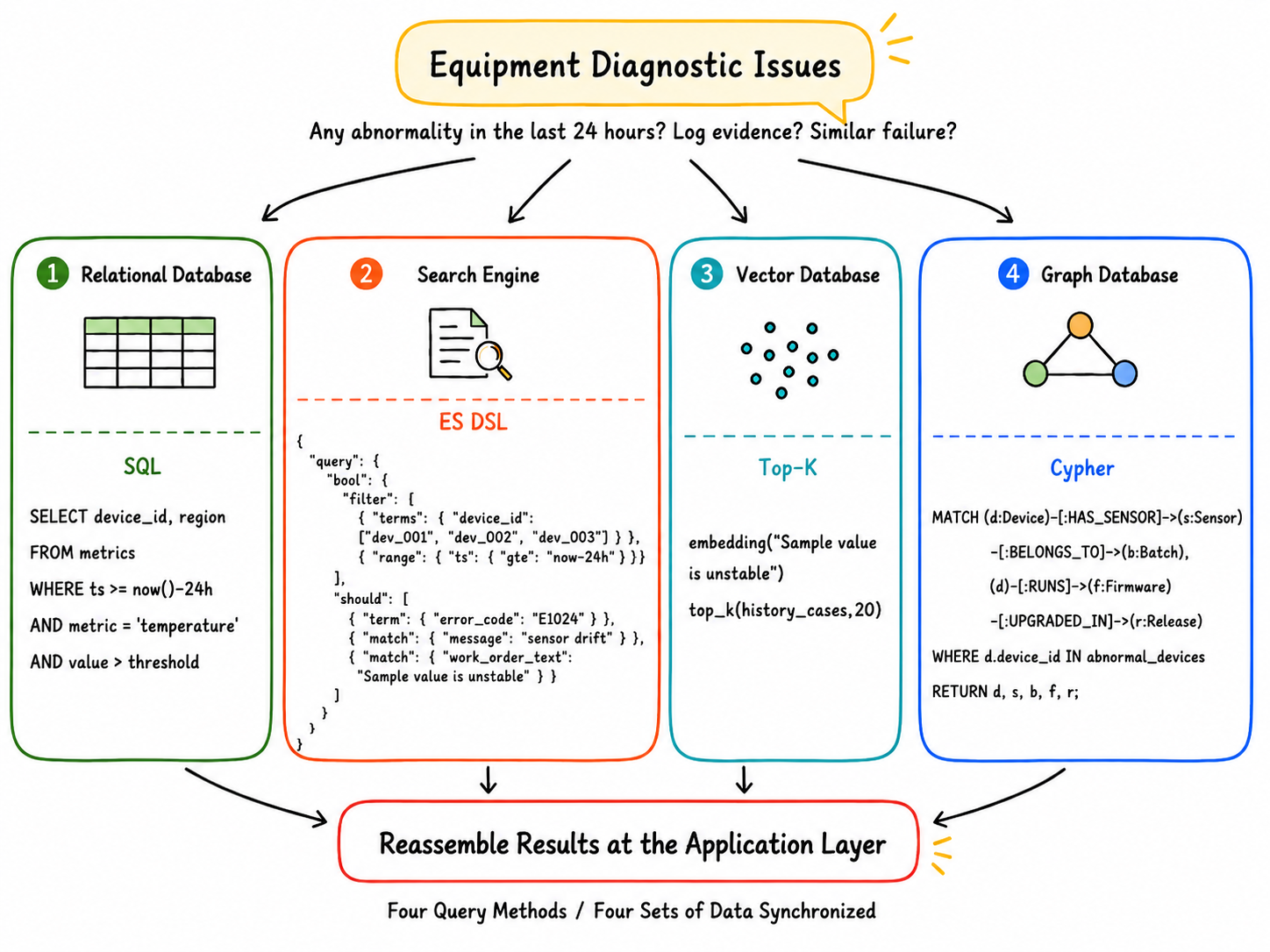
Although this approach appears modular, it introduces long retrieval chains and new data silos. The same business data must be repeatedly synchronized and moved across multiple systems. Permissions, security policies, and data definitions must also be maintained separately. Once data is continuously updated, or queries need to span filtering, association, recall, and analysis across systems, consistency, real-time performance, and explainability become difficult to guarantee.
Therefore, enterprise AI retrieval is not about stitching together more retrieval components. It is about unifying structured filtering, graph traversal, full-text search, semantic recall, and analytical reasoning within a single, governable data foundation.
This is exactly the challenge YMatrix aims to solve.
To address the above challenges, YMatrix proposes a unified data foundation where business rules, temporal changes, relational paths, textual evidence, and semantic knowledge collaborate around the same set of business data. This eliminates the need for repeated data movement and system stitching, enabling retrieval, analysis, and reasoning within a richer business context.
From a database capability perspective, this retrieval chain does not correspond to a single feature, but to the coordination of multiple capabilities:
What YMatrix aims to achieve is enabling these capabilities to operate on the same dataset within a single database engine. This can be summarized as five steps: precise filtering, change analysis, relationship tracing, evidence retrieval, and similarity search.
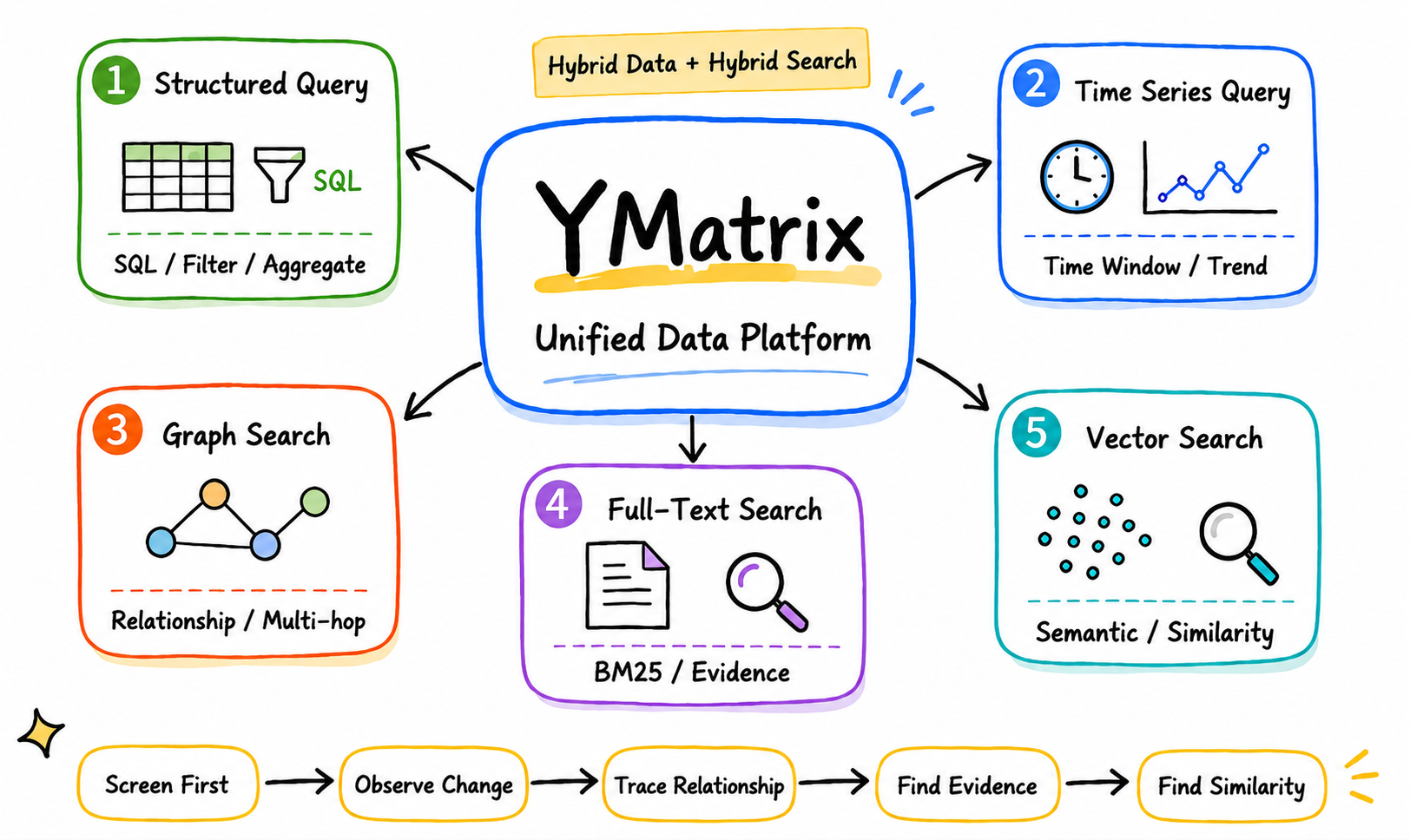
For many enterprise AI problems, the first step is not semantic recall, but defining the query boundary.
“Last 24 hours,” “specific region,” “certain device batch,” “certain firmware version,” and “values exceeding thresholds”—all these conditions must be handled through structured queries. YMatrix natively supports SQL, multi-table joins, aggregation, window functions, Lateral joins, and other advanced analytical capabilities, allowing natural language questions to be narrowed into precise data scopes.
At the same time, YMatrix’s vectorized execution engine is designed for columnar storage and analytical workloads. Through batch processing, reduced function calls, CPU cache and SIMD utilization, and column-wise access, it improves execution efficiency.
For AI scenarios, this capability ensures “precise filtering before analysis,” preventing AI from retrieving overly broad datasets. This layer answers: Is the data scope seen by AI correct?
Many enterprise AI problems are not static queries.
Device diagnostics require understanding metric fluctuations; operations analysis requires detecting when failures began to spread; risk control scenarios require identifying whether certain behaviors emerged in bursts over time. What is needed is not just retrieving a record, but analyzing time windows, trends, anomalies, and aggregated patterns.
YMatrix has long built capabilities for time-series and real-time analytics, supporting high-concurrency writes, out-of-order and batch ingestion, time-series functions (such as last_value, time_bucket), tiered hot/cold data storage, and horizontal cluster scaling.
For AI scenarios, this capability brings continuously evolving data into a unified retrieval chain, shifting the question from “Is there an anomaly?” to “When did it occur, how did it spread, and is it concentrated in a specific device type or region?” This layer answers: Can AI understand temporal evolution?
Many enterprise AI problems cannot be explained by a single record.
A device may be linked to multiple sensors; a sensor belongs to a batch; a batch corresponds to a firmware version; and a firmware version may relate to upgrades, tickets, and regions. To determine whether anomalies share a common root cause, AI must traverse relationships rather than analyze isolated points.
YMatrix provides native graph query capabilities accessible through SQL. Within the same database context, it supports pattern matching, multi-hop traversal, variable-length path queries, shortest path, path counting, label filtering, and cycle detection.
At the execution level, optimizations such as GraphBLAS/LAGraph, VLE rewrite, matrix pruning, and count-only fast paths reduce unnecessary path expansion and intermediate results.
This enables AI to trace from an anomalous device to related sensors, same-batch devices, firmware versions, historical tickets, and similar failure chains. This layer answers: Can AI connect scattered signals into relational paths?
AI-generated answers must go beyond semantic similarity and return to verifiable evidence. In logs, tickets, maintenance records, knowledge bases, and business documents, critical information often exists as error codes, alert messages, resolution descriptions, and human annotations rather than structured fields. YMatrix provides native full-text search capabilities designed for modern search scenarios. Its BM25-based ranking ensures that results are not only matched by term occurrence but also ranked by relevance.
For AI scenarios, this enables answers to move from model inference to business evidence: which logs contain the same error code, which tickets describe similar issues, and which documents record resolution steps—all traceable within the same query chain.
This layer answers: Can AI responses be backed by verifiable and explainable textual evidence?
In enterprise data, the same type of problem is often described in different ways. In failure records, one may say “metric fluctuation,” another “unstable sampling values,” and another “periodic drift.” Keyword matching alone would miss much historical experience. YMatrix supports vector storage and similarity search, enabling text, knowledge snippets, tickets, and failure cases to be embedded as vectors and retrieved via semantic similarity.
In terms of capability, it supports exact and approximate nearest neighbor search, multiple distance metrics, and indexing methods such as HNSW and IVFFlat for large-scale vector retrieval.
For AI agents, this means they can retrieve semantically similar experiences across different expressions, documents, and historical records without relying on identical keywords. This layer answers: Can AI find similar experiences behind different expressions?
With these five capabilities, the earlier device diagnostics problem can be expressed within a single SQL context in YMatrix. This not only simplifies application development but also reduces the complexity of data synchronization, result alignment, and permission management.
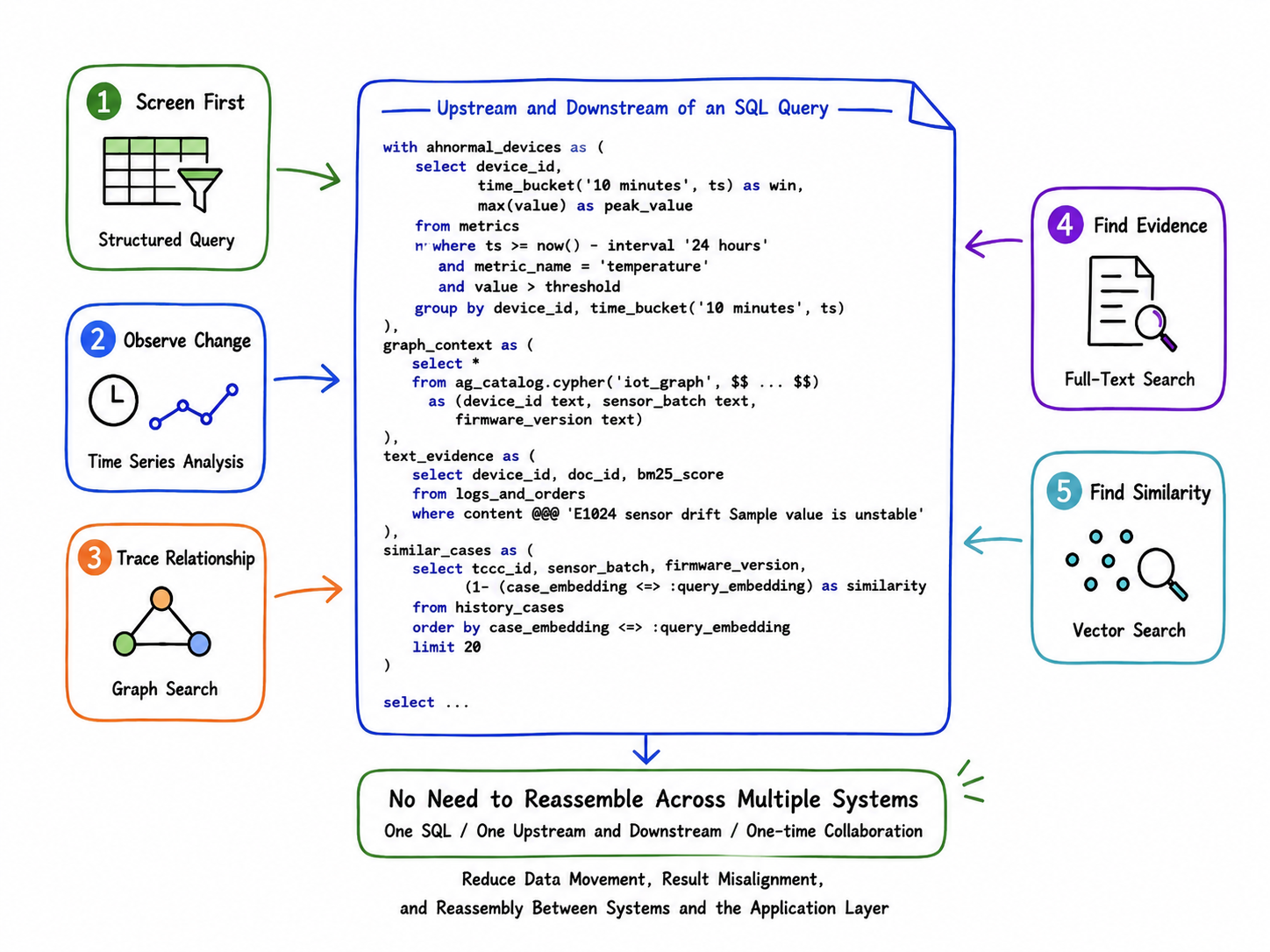
In the AI era, enterprises do not need system sprawl. They need a unified data foundation that connects business rules, temporal evolution, relational paths, textual evidence, and semantic knowledge.
The core value of YMatrix is to power this hybrid retrieval chain with a unified database engine, enabling structured queries, time-series analysis, graph retrieval, full-text search, vector search, and analytical capabilities to work together on the same dataset—building a unified, trustworthy, and governable data foundation for the AI era.
In-depth Analysis (Part 2) — In the AI Era, Databases Are Entering the “Unified Storage Era”
In-depth Analysis (Part 1) — In the AI Era, Databases Are Entering the “Unified Storage Era”
Smart Manufacturing at Scale with YMatrix HTAP: Real-Time Ingestion & Unified Analytics
Ganfeng Lithium: Real-Time Reporting at Scale with YMatrix
PXF: Cross-Source Queries in Seconds with YMatrix
YMatrix HTAP Transforms Month-End Closing for a 16,000-Store Pharma Chain


